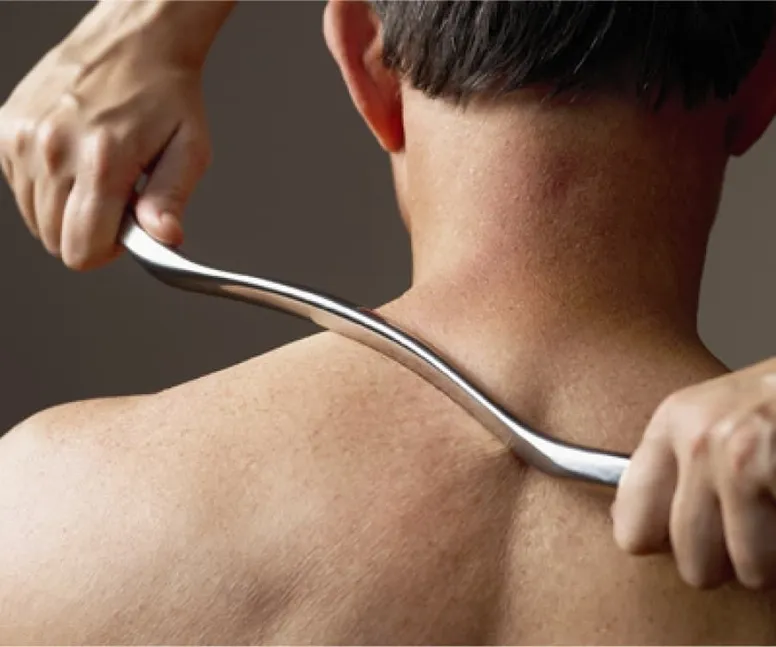
Graston Technique is a form of Instrument Assisted Soft Tissue Manipulation(IASTM); and are manual therapy techniques that uses specialized instruments to apply pressure to lesions, scar tissue or adhesions in the soft tissues of the body, such as muscles, tendons, and fascia. The instruments used are typically made of stainless steel and have a unique beveled edge. The technique involves the therapist applying pressure to the affected area and then dragging the instrument along the tissue.
IASTM is administered by a trained and certified practitioner who uses the specialized instruments to apply pressure to the affected area. The practitioner may use one or more instruments, depending on the specific condition being treated. The technique involves the practitioner using the instruments to apply controlled pressure to the affected area, followed by gentle stretching and range-of-motion exercises to help improve soft tissue function and promote healing. The goal of IASTM / Graston Technique is to improve soft tissue function, reduce pain and swelling, and promote healing. The theory behind IASTM is that the specialized instruments can help to break up scar tissue and adhesions, which can lead to reduced pain and improved range of motion. The technique is also thought to improve circulation, which can help to reduce inflammation and promote healing. IASTM / Graston Technique is commonly used to treat a variety of conditions, including musculoskeletal injuries, chronic pain, and post-surgical rehabilitation. It is also used to treat conditions such as plantar fasciitis, tendinitis, and rotator cuff injuries. Before starting IASTM or Graston Technique, it is important to consult with a healthcare provider to determine if it is appropriate for your specific condition.
References
- Bedard M, Hebert-Davies J, Varin D, Parent H, Vendittoli PA. Preoperative use of the Graston technique for moderate to severe hip osteoarthritis: a case series. J Can Chiropr Assoc. 2014;58(3):308-315. PMID: 25202143.
- Davidson CJ, Ganion LR, Gehlsen GM, et al. Rat tendon morphologic and functional changes resulting from soft tissue mobilization. Med Sci Sports Exerc. 1997;29(3):313-319. doi: 10.1097/00005768-199703000-00004
- Gehlsen GM, Ganion LR, Helfst R. Fibroblast responses to variation in soft tissue mobilization pressure. Med Sci Sports Exerc. 1999;31(4):531-535. doi: 10.1097/00005768-199904000-00013
- Heng D, Ferry S, Isakov R. Effects of Graston technique on pain and function in patients with plantar fasciitis: a case series. Int J Ther Massage Bodywork. 2015;8(1):4-11. doi: 10.3822/ijtmb.v8i1.271
- Hidaka E, Imai K, Yonezawa T, et al. Effectiveness of the Graston technique for pain and range of motion in patients with chronic ankle instability: a randomized controlled trial. J Phys Ther Sci. 2020;32(1):21-25. doi: 10.1589/jpts.32.21
- Honrado CP, Oliveira MS, Ribeiro IL, et al. Effects of Graston technique on pain intensity, disability, and kinesiophobia in women with fibromyalgia: a randomized controlled trial. J Manipulative Physiol Ther. 2017;40(9):635-642. doi: 10.1016/j.jmpt.2017.06.002
- McKechnie L, Jakeman P, McKechnie S, et al. The effects of instrument-assisted soft tissue mobilization compared to other interventions on pain and function: a systematic review. J Bodyw Mov Ther. 2018;22(4):1027-1038. doi: 10.1016/j.jbmt.2018.01.014
- Mittag O, Schmitz A, Duda S, et al. Randomized controlled trial of the Graston technique for acute hamstring injuries. Scand J Med Sci Sports. 2021;31(1):48-57. doi: 10.1111/sms.13710
- Schillinger A, Plews DJ, Hawkins RD, et al. The effect of Graston technique on hamstring flexibility in physically active individuals. J Man Manip Ther. 2016;24(4):206-214. doi: 10.1179/2042618615Y.0000000015
- Thelen MD, Dauber JA, Stoneman PD. The clinical efficacy of Graston technique and active release technique in the treatment of Achilles tendinopathy: a case series. J Orthop Sports Phys Ther. 2008;38(9):A32. doi: 10.2519/jospt.2008.0301